

Choosing the right small business financing option depends on what you need the money for, how quickly you need it, your business’s financial health, and how comfortably you can manage the payments.
Common types of financing for small businesses include term loans, business lines of credit, SBA loans, business credit cards, merchant cash advances, equipment financing, invoice financing, and microloans. Each works differently, and the right option for one business may not be appropriate for another.
For example, a restaurant purchasing inventory may have different financing needs than a contractor buying equipment or a retail business preparing for its busiest season.
Understanding the differences can help you compare costs, evaluate eligibility, and choose funding that supports your business without creating unnecessary financial pressure.
What Are the Main Types of Small Business Financing?
Small business financing generally falls into several categories:
- Installment financing: You borrow a specified amount and repay it according to an agreed schedule, often with interest.
- Revolving credit: You can draw funds as needed, up to an approved limit, subject to the agreement.
- Receivables-based financing: Financing is connected to invoices, expected payments, or future business revenue.
- Asset-based financing: Funding is used to purchase assets or is secured by assets such as equipment.
- Government-supported lending: Programs such as SBA loans help eligible businesses access financing through participating lenders.
Some funding products can fit more than one category. The important differences are how the funds are provided, how the provider is compensated, what obligations the business accepts, and how the arrangement affects cash flow.
Small Business Financing Options at a Glance
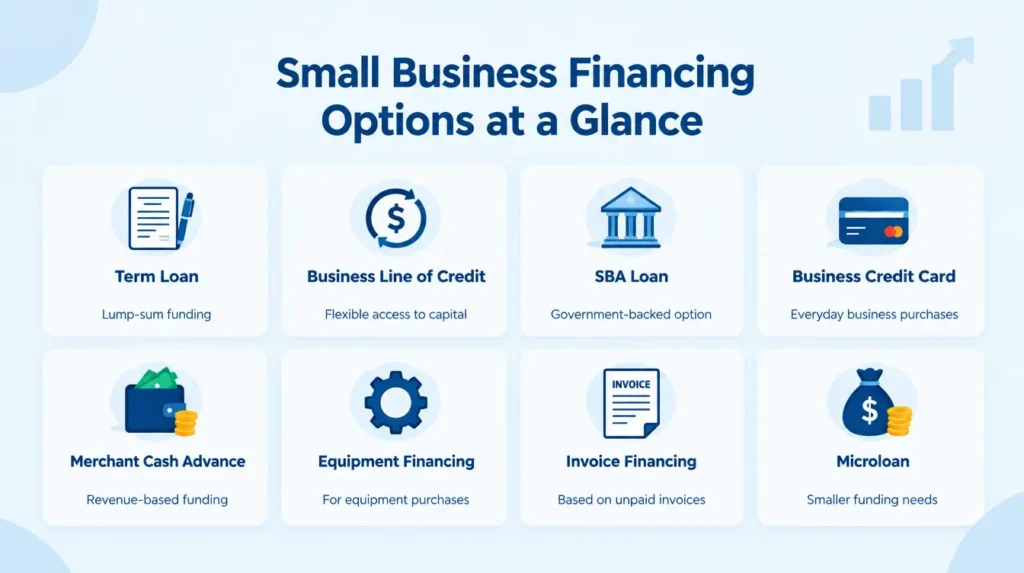
| Financing option | Common use | Payment structure | Main consideration |
| Term loan | Expansion, major purchases, working capital | Scheduled installments | Interest, fees, and repayment obligations |
| Business line of credit | Recurring or unexpected expenses | Payments based on credit agreement and balance | Variable rates, fees, and credit limits |
| SBA loan | Eligible expansion, working capital, equipment | Loan repayment according to program terms | Eligibility, documentation, and processing |
| Business credit card | Routine expenses and smaller purchases | Revolving balance with required payments | Interest if balances are carried |
| Merchant cash advance | Short-term business cash-flow needs | Remittances from future receivables or revenue under the agreement | Total cost and payment frequency |
| Equipment financing | Machinery, vehicles, or equipment | Scheduled financing payments | Equipment value and financing obligations |
| Invoice financing | Cash tied up in unpaid customer invoices | Advance or facility settled under invoice terms | Fees and customer payment risk |
| Microloan | Smaller startup or growth needs | Loan payments under the agreement | Funding limits and provider requirements |
No option is automatically the cheapest, fastest, or easiest to qualify for. Compare actual offers rather than relying on general product descriptions.
1. Business Term Loans
A business term loan provides a specific amount of money that the borrower repays over an agreed period, usually through scheduled installments.
Term loans are available from banks, credit unions, and some online or non-bank lenders. Depending on the agreement, interest may be fixed or variable.
When Does a Term Loan Make Sense?
A term loan may be appropriate when a business has a defined expense and expects enough future cash flow to manage regular payments.
Common uses include:
- Expanding or renovating business premises
- Purchasing inventory or equipment
- Financing a planned business project
- Supporting working capital needs
- Refinancing eligible existing business debt
A fixed-rate loan with predictable payments can make budgeting easier. A variable-rate loan may expose the business to payment changes if interest rates move.
What Should You Consider Before Applying?
Lenders may evaluate the business’s revenue, credit history, cash flow, operating history, existing debt, and potential collateral.
Review the annual percentage rate (APR), fees, repayment schedule, prepayment terms, and any personal guarantee requirements.
A term loan can be useful for a planned investment, but a payment schedule that is too aggressive can strain cash flow even when the business is profitable.
If traditional financing is unavailable, understanding where to go when banks say no can help you explore alternative funding structures while evaluating their potential costs and limitations.
2. Business Lines of Credit
A business line of credit provides access to funds up to an approved borrowing limit.
Unlike a traditional term loan, which typically delivers money in a lump sum, a line of credit allows the business to draw funds when needed, subject to the provider’s terms.
With a revolving line of credit, repaying borrowed amounts may restore available borrowing capacity.
When Is a Business Line of Credit Useful?
A line of credit can help cover expenses that arise at different times, such as:
- Unexpected repairs
- Short-term payroll gaps
- Inventory purchases
- Seasonal operating expenses
- Delays between paying suppliers and receiving customer payments
For example, a retailer might use a business line of credit to purchase additional inventory before a busy sales period and pay down the balance as customer revenue arrives.
Businesses that experience predictable busy and slow periods may also benefit from understanding short-term financing for seasonal businesses before selecting a credit product.
What Are the Potential Drawbacks?
Lines of credit may have variable interest rates, draw fees, maintenance fees, renewal conditions, or other requirements.
Lenders can also restrict future draws under certain circumstances.
Business owners should understand when interest begins accruing, whether unused credit carries a fee, and whether a draw triggers a fixed repayment schedule.
A line of credit can provide flexibility, but it is still borrowed money that must be repaid under the agreement.
3. SBA Loans
Small Business Administration (SBA) loan programs help eligible small businesses obtain financing through participating lenders and lending organizations.
The SBA generally guarantees a portion of eligible loans rather than lending directly to businesses through its main loan programs.
What Types of SBA Loans Are Available?
Several SBA programs serve different business purposes.
SBA 7(a) loans can support eligible working capital, equipment purchases, business acquisitions, real estate, and other approved needs.
SBA 504 loans focus primarily on eligible fixed assets, such as major equipment and owner-occupied commercial real estate. They are not intended for ordinary working capital or inventory purchases.
SBA Microloans provide smaller loans through approved intermediary organizations and may support eligible startup, inventory, equipment, and working capital needs.
Program rules, maximum amounts, and eligible uses differ.
Who Should Consider SBA Financing?
SBA loans may be worth exploring if your business qualifies, has an eligible financing purpose, and can complete the required underwriting and documentation process.
Lenders consider factors such as creditworthiness, business operations, repayment capacity, and applicable program requirements.
If your need is not urgent, comparing SBA financing with conventional business loans can help determine whether a longer-term solution would be more suitable.
For current program details, visit the U.S. Small Business Administration’s loan information.
4. Business Credit Cards
Business credit cards are revolving credit products that allow approved businesses to make purchases within an established credit limit.
They are often used for everyday operating expenses rather than major long-term financing needs.
What Can a Business Credit Card Be Used For?
Common expenses include:
- Office supplies
- Software subscriptions
- Business travel
- Marketing purchases
- Smaller equipment or supply purchases
- Recurring operating expenses
Some cards offer cash-back rewards, travel benefits, or other incentives. However, rewards should not be the main reason to take on expensive revolving debt.
Are Business Credit Cards a Good Financing Option?
Business credit cards may be convenient for managing smaller, recurring expenses when the business can pay its balance on time.
Carrying a balance can lead to significant interest charges. Cash advances may also have separate fees and interest rules.
Approval and available credit depend on the card issuer’s assessment. Some products require strong personal credit, while other cards have different underwriting models.
Before applying, compare the purchase APR, annual fee, introductory offers, credit limits, and personal liability terms.
A business credit card can be a useful payment tool, but it is not necessarily a substitute for financing a large business investment.
5. Merchant Cash Advances (MCAs)
A merchant cash advance is a business funding arrangement generally structured around the purchase of future receivables or revenue.
A business receives an upfront advance in exchange for an agreed amount of its future business receipts.
Unlike a conventional term loan, an MCA is typically structured as a purchase of future receivables rather than a standard loan with a conventional interest rate.
However, the legal treatment and obligations depend on the agreement and applicable law.
For a detailed explanation of the product, including costs and risks, read our guide to what a merchant cash advance is.
How Does a Merchant Cash Advance Work?
The basic process involves three elements:
- A funding provider evaluates the business’s revenue, deposits, financial condition, and other underwriting factors.
- If approved, the business receives an advance under the agreed terms.
- The business remits the contracted amount according to the agreement, which may involve daily or weekly withdrawals or a percentage of eligible receipts.
Some agreements use fixed remittance amounts, while others involve variable collections tied to sales. Reconciliation provisions, if included, may affect how payments respond to changes in revenue.
When Might a Small Business Consider an MCA?
A merchant cash advance may be considered by an established business that generates regular revenue but has difficulty accessing conventional financing or needs to address a time-sensitive cash-flow requirement.
Possible uses include:
- Purchasing inventory to meet customer demand
- Paying for an urgent equipment repair
- Managing a temporary operating expense
- Covering certain seasonal cash-flow gaps
- Addressing an immediate business opportunity
The expected benefit should justify the full cost of the funding.
An MCA generally requires careful consideration because frequent remittances can put substantial pressure on operating cash flow.
What Does a Merchant Cash Advance Cost?
MCA providers may express pricing using a factor rate or a specified total purchased amount rather than a traditional loan interest rate.
Business owners should examine:
- The amount of cash actually received
- The total contracted remittance or purchased amount
- Any applicable fees or deductions
- The amount and frequency of withdrawals
- Whether reconciliation is available
- The treatment of early completion or default
- Any security interests or personal guarantees
A factor rate is not the same as an APR. Comparing an MCA with a loan requires considering its total cost and expected payment timing, not just a single quoted rate.
An MCA should not automatically be treated as an inexpensive alternative to a bank loan.
Can Businesses With Bad Credit Consider an MCA?
Some MCA providers place substantial weight on business revenue and deposit activity rather than relying only on a personal credit score.
This can make an MCA worth investigating for business owners who have been declined for conventional loans.
However, bad credit does not guarantee MCA approval, and credit checks or credit-related underwriting may still apply.
Providers may review business performance, existing financial obligations, banking history, and the ability to sustain the proposed remittances.
A business with a lower credit score should carefully compare the total funding cost against its expected revenue before accepting an offer.
Our Merchant Cash Advance Funding Options
We provide merchant cash advance funding for qualifying businesses.
If you’re considering an MCA, explore the available merchant cash advance funding options and review the application requirements before proceeding.
Funding availability, eligibility, and terms depend on underwriting and the final agreement.
6. Equipment Financing
Equipment financing helps businesses acquire machinery, vehicles, technology, and other equipment required for daily operations or expansion.
Depending on the financing structure, a business might obtain an equipment loan or lease.
How Does Equipment Financing Work?
With an equipment loan, the business borrows money to purchase eligible equipment and repays it under the agreed loan terms. The equipment itself may serve as collateral.
With an equipment lease, the business pays to use equipment under a leasing agreement. Ownership and end-of-term options depend on the lease.
Equipment financing may be useful for:
- Construction machinery
- Commercial vehicles
- Manufacturing equipment
- Restaurant appliances
- Medical or dental equipment
- Business technology
What Are the Advantages and Limitations?
Matching financing to the equipment’s expected useful life can help businesses avoid paying the full purchase cost upfront.
However, owners should compare the total financing or leasing expense, equipment depreciation, maintenance responsibilities, insurance, and any end-of-term purchase obligations.
Financing equipment over a long period may be inappropriate if the asset becomes obsolete sooner than expected.
7. Invoice Financing
Invoice financing provides access to working capital based on eligible outstanding customer invoices.
It is often considered by businesses that sell products or services to other businesses and offer customers payment terms.
How Does Invoice Financing Work?
A business with unpaid invoices may receive an advance based on eligible receivables.
Depending on the structure, the provider may collect payments directly from customers or require the business to repay the advance after receiving payment.
Invoice factoring is a related but distinct arrangement in which invoices are sold to a factoring company.
Which Businesses Might Benefit?
Invoice-based funding may be relevant to:
- Wholesale distributors
- Staffing companies
- Manufacturers
- Logistics providers
- Business-to-business service companies
For example, a company may have completed a customer order but still be waiting for payment. Invoice financing can potentially provide liquidity during that gap.
The cost depends on the provider, invoice quality, customer creditworthiness, and financing arrangement.
Business owners should also evaluate customer notification requirements, collection practices, recourse provisions, and the consequences of late or unpaid invoices.
8. Microloans
Microloans are smaller business loans that may help entrepreneurs and small companies finance limited startup or operating needs.
They are offered through various community lenders, nonprofit lending organizations, and programs such as the SBA Microloan Program.
What Can a Microloan Be Used For?
Depending on the program, eligible uses may include:
- Purchasing supplies or inventory
- Buying smaller equipment
- Financing furniture or fixtures
- Supporting approved working capital needs
- Making modest improvements to business operations
Microloans may be worth exploring when a business needs a smaller amount than a traditional commercial lender typically offers.
However, requirements vary. Lenders may evaluate repayment capacity, business plans, credit history, and other relevant information.
Entrepreneurs should also check whether a lender offers business counseling or technical assistance.
Which Small Business Financing Options Are Available With Bad Credit?
Business owners with lower credit scores may still have financing options, but availability depends on more than credit alone.
Different providers use different underwriting models.
For example:
- Term loan providers may assess business revenue, personal and business credit, collateral, and existing debts.
- Business line of credit providers may review cash flow, operating history, and creditworthiness.
- MCA providers may place greater emphasis on business deposits and revenue patterns, although credit and other risks can still matter.
- Equipment financing providers may consider the value and condition of the equipment alongside borrower qualifications.
- Certain community lenders and microlenders may offer programs with different eligibility assessments.
If you’re searching for a bad credit business cash advance or small business funding with limited credit history, focus on whether the business can responsibly support the financing.
A product being available does not necessarily make it affordable.
What If Your Business Has Limited Credit History?
A newer business may not have the financial history required by some traditional lenders.
Depending on the financing option, providers may request evidence of current revenue, banking activity, existing contracts, customer invoices, or other financial information.
Before applying, organize your records and determine which financing products actually fit your stage of business.
Businesses facing lending challenges can also explore alternative financing options when banks decline an application, while carefully comparing funding costs and contractual obligations.
Avoid assuming that a product advertised as a no-credit-check business advance is automatically easier to obtain or safer to use.
Which Small Business Financing Options Can Provide Funding Quickly?
Business owners facing urgent expenses often search for fast business funding, short-term loans, or cash advances.
However, there is no single financing type that is always fastest.
Funding speed can depend on:
- The lender or funding provider
- Whether the business already has an approved credit facility
- The completeness of application documents
- Credit and financial reviews
- The complexity of underwriting
- Contract execution and bank processing
An existing, accessible business line of credit may provide a different funding experience than applying for a new term loan or MCA.
Online financing providers may offer streamlined application processes, but actual approval and funding times are not guaranteed.
What Should You Compare When Funding Is Urgent?
Start by asking what the funds are needed for and when the payment must be made.
Then compare the expected availability of funds against the total financing cost.
Do not accept a significantly more expensive offer simply because it advertises rapid funding. Confirm the timing and terms directly with the provider.
If the funding is needed to cover an immediate expense, calculate whether your expected revenue can support the required payments afterward.
For businesses whose funding needs change with sales cycles, our article on managing seasonal financing needs provides additional context for evaluating short-term cash-flow decisions.
How Do You Choose the Right Small Business Financing Option?
The right financing structure should match your business purpose, revenue pattern, financial condition, and payment capacity.
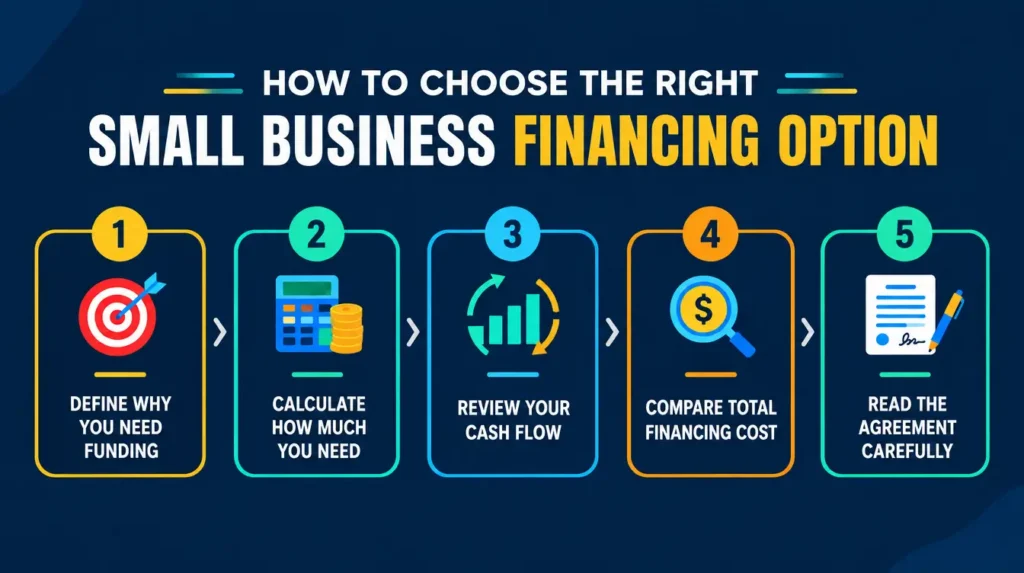
These five steps can help narrow your options.
Step 1: Define Why Your Business Needs Funding
Start with a specific purpose.
Are you purchasing equipment, covering a temporary cash-flow gap, financing inventory, or making a long-term investment?
A long-term expansion project may require a different financing structure than a short-term operating expense.
Step 2: Determine How Much Funding You Actually Need
Estimate the full expense and identify how much you can cover using existing cash reserves.
Borrowing or obtaining more funding than necessary can increase your financing costs and financial obligations.
Keep enough working capital available for essential expenses, including payroll, rent, taxes, and suppliers.
Step 3: Evaluate Your Business Cash Flow
Review recent bank statements, revenue trends, recurring expenses, and existing financial obligations.
If your business experiences seasonal fluctuations, consider whether payments remain manageable during slower periods.
A financing arrangement should support operations rather than leave the business unable to cover essential expenses.
Step 4: Compare the Total Cost of Financing
Do not compare financing offers using only the advertised interest rate or factor rate.
Ask each provider for a clear breakdown of:
- Net funds delivered to the business
- Interest, finance charges, or purchased receivables amount
- Origination and other applicable fees
- Total amount the business must pay or remit
- Payment amounts and frequency
- Estimated repayment or remittance period
- Early repayment or completion conditions
- Personal guarantees and security requirements
Loan offers may be evaluated using APR and total borrowing costs. Merchant cash advances require additional attention to their total contracted cost, expected duration, and remittance structure.
Step 5: Review the Agreement Before Signing
Read the complete agreement, not just the offer summary.
Pay attention to automatic withdrawals, changes in payment obligations, default provisions, reconciliation procedures, and any restrictions affecting your business.
Consider speaking with a qualified financial or legal professional before accepting a financing arrangement you do not fully understand.
Term Loans vs. Lines of Credit vs. Merchant Cash Advances
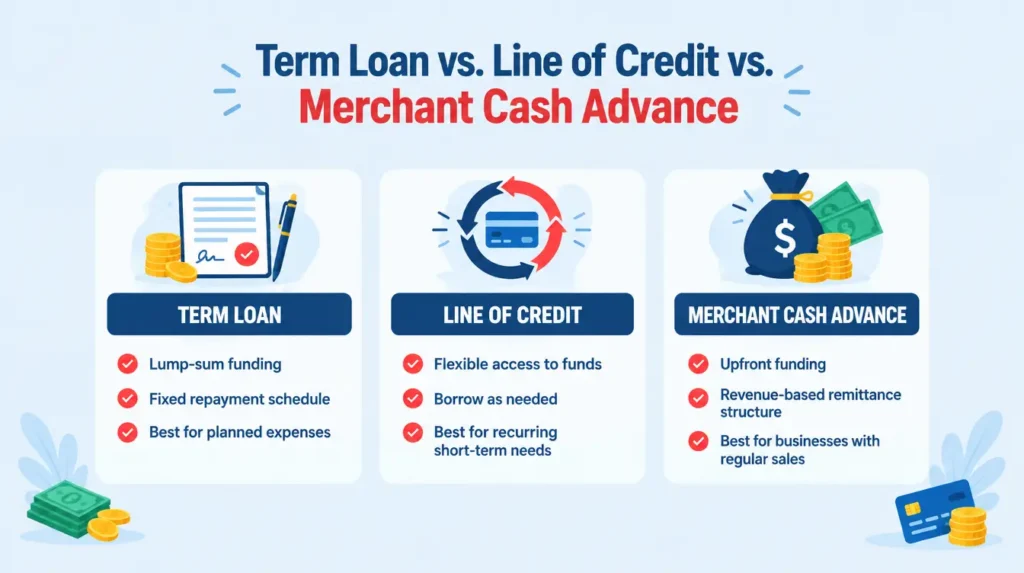
These three financing structures often appear in the same small business funding search, but they serve different needs.
A term loan provides a specified amount that is repaid according to an installment schedule.
A business line of credit generally allows borrowing and repayment within an approved credit arrangement, subject to its terms.
A merchant cash advance typically provides upfront funding in exchange for a contracted amount of future receivables or revenue.
A business with predictable cash flow and a major planned purchase may prefer evaluating a term loan. A business with recurring short-term needs may explore a line of credit.
An established business with regular revenue that cannot obtain suitable conventional financing may also consider an MCA, provided the cost and remittance obligations are manageable.
For a more detailed breakdown of their structures and potential trade-offs, review the differences between business loans, lines of credit, and merchant cash advances.
What Documents Do You Need to Apply for Business Financing?
Documentation requirements vary by financing product and provider.
Depending on the application, businesses may be asked for:
- Business identification and ownership information
- Recent business bank statements
- Revenue or sales records
- Business and personal tax returns
- Profit-and-loss statements
- Balance sheets
- Existing debt or funding agreements
- Equipment purchase information or outstanding invoices
Not every provider requires every document.
For example, an equipment financing provider may request information about the equipment, while an invoice financing provider may need to evaluate eligible customer receivables.
Keeping accurate and current records helps you understand your own financial position and respond to underwriting requests.
If you are considering an MCA, reviewing the merchant cash advance document requirements can help you identify the information that may be requested during the submission process.