

A merchant cash advance, commonly called an MCA, provides a business with upfront capital in exchange for an agreed amount of future business receivables.
Unlike a traditional business loan, an MCA is generally structured around the purchase of future receivables. The business receives capital upfront and then remits the purchased amount according to the terms of its agreement.
For business owners, the important questions are not limited to how much capital is available. You also need to understand how the advance works, what it costs, how remittances affect cash flow, what happens when revenue changes, and whether another funding option may be more appropriate.
This guide explains those points before you decide whether to pursue merchant funding.
What Is a Merchant Cash Advance?
A merchant cash advance is a form of business funding in which a company receives capital upfront in exchange for an agreed amount of future receivables.
The amount the business receives and the amount it ultimately remits are established in the funding agreement. Remittances are commonly made daily or weekly from the business bank account, depending on the structure of the agreement.
MCAs are often considered by businesses that need capital for a time-sensitive purpose and may not want to wait through a lengthy traditional bank underwriting process.
The exact terms can vary significantly between offers, which is why business owners should evaluate the complete agreement rather than focusing only on the amount of capital offered.
Check My Merchant Funding Options
How Does a Merchant Cash Advance Work?
At a high level, the merchant cash advance process can be divided into five stages.
Submit an Application – Provide basic business information and requested financial documents.
Business Review – The business and its financial activity are reviewed during underwriting.
Review the Offer – Review the proposed funding structure and agreement terms.
Complete the Agreement and Receive Funding – Complete the required documentation before funds are provided.
Remit the Purchased Amount – Make remittances according to the terms of the funding agreement.
For a detailed explanation of each stage, see our step-by-step guide to how a merchant cash advance works.
How Much Merchant Cash Advance Funding Can a Business Receive?
There is no universal MCA funding amount.
The amount available to a business depends on the provider’s underwriting standards and the financial profile of the applicant.
Common factors include the following.
Monthly Business Revenue
Monthly revenue helps indicate how much capital the business may reasonably be able to support.
Higher revenue does not automatically mean that a business should accept a larger amount. Cash flow, expenses, existing obligations, and the intended use of funds also matter.
Deposit Consistency
Two businesses can generate similar annual revenue while having very different deposit patterns.
Underwriters may evaluate whether deposits are stable, highly seasonal, declining, increasing, or unusually volatile.
Time in Business
Operating history provides additional information about how the business performs over time.
Minimum requirements differ among providers.
Industry
Revenue cycles and operating patterns vary by industry.
A restaurant, construction company, retailer, medical practice, transportation company, and e-commerce business may have very different margins, deposit patterns, seasonality, and working-capital needs.
Existing Financial Obligations
Current obligations can reduce the amount of cash flow available to support an additional remittance.
An underwriting review should consider whether the business can reasonably support the proposed structure alongside its existing commitments.
Overall Business Cash Flow
The objective should not automatically be to obtain the largest available amount.
A responsible funding amount should make sense in relation to:
- revenue
- deposit history
- operating expenses
- existing obligations
- expected use of funds
- anticipated business cash flow
Legend Advance Funding’s Current Published Range
Legend Advance Funding currently publishes Business Cash Advance amounts ranging from $20,000 to $3 million.
Legend states that the amount offered depends primarily on factors such as average monthly deposits, time in business, industry, and existing funding obligations. Business owners can review the current Business Cash Advance program for Legend’s published merchant criteria.
The published range is not a promise that an applicant will qualify for a particular amount. Actual availability depends on underwriting and the circumstances of the business.
Merchant Cash Advance Requirements and Funding Amounts
Merchant cash advance requirements are generally based heavily on the operating performance and cash flow of the business.
For Legend’s current merchant program, the baseline requirements include:
| Requirement | Current Baseline |
| Time in business | 3 months or more |
| Monthly revenue | $20,000 or more |
| Business bank account | Active U.S. business checking account |
| Personal credit | No strict minimum FICO for most programs |
| Existing advances | Reviewed case by case |
| Geographic availability | All 50 states |
Legend currently offers merchant funding from $20,000 to $3 million, subject to underwriting.
Your available amount depends on the individual business. Underwriters may consider deposit volume, consistency, existing obligations, industry, time in business, and overall cash-flow capacity.
A lower personal credit score does not automatically prevent a business from being considered because Legend evaluates business performance alongside credit information.
How Do Merchant Cash Advance Remittances Work?
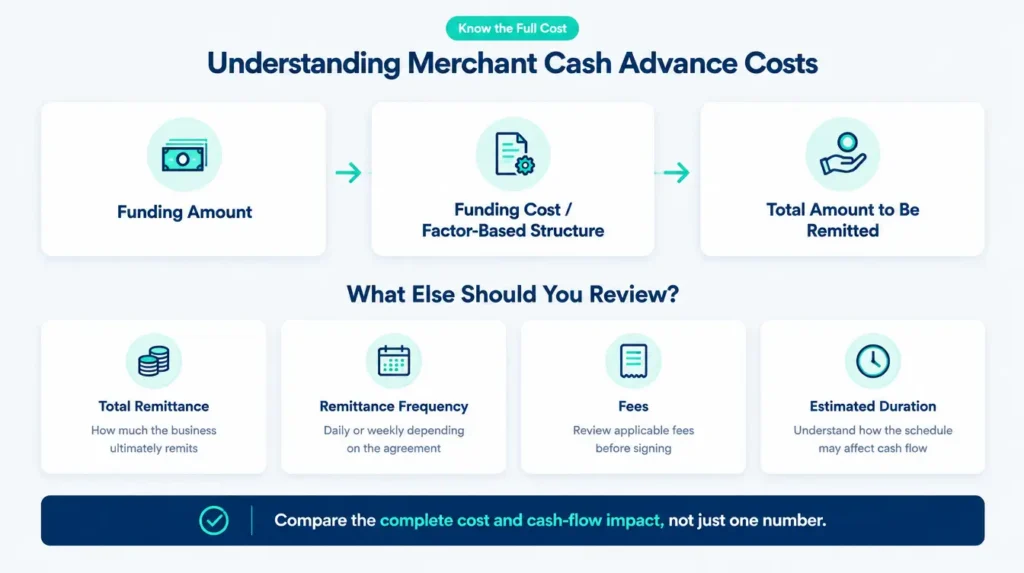
Merchant cash advance cost is not typically evaluated the same way as a conventional term loan.
Some MCA agreements use a factor-based structure. The business receives one amount and agrees to remit a higher purchased amount over the course of the agreement.
The most useful way to understand the cost is to look at the actual dollars involved.
Illustrative MCA Cost Example
The following example is hypothetical and does not represent a Legend Advance Funding offer or standard pricing.
| Item | Illustrative Amount |
| Net proceeds received by business | $50,000 |
| Purchased amount | $65,000 |
| Dollar cost | $15,000 |
| Scheduled daily remittance | $500 |
| Estimated business days to complete | 130 |
In this example:
$65,000 ÷ $500 = 130 business days
The business receives $50,000 and ultimately remits $65,000 under the hypothetical agreement.
The $15,000 difference represents the dollar cost before considering any other applicable terms or fees.
This example is intentionally expressed in dollars rather than as an APR because an MCA and a traditional interest-bearing business loan are structured differently.
Actual offers vary by business and agreement.
Merchant Cash Advance Pros and Cons
Merchant cash advances can solve specific short-term funding needs, but they also create obligations that can affect daily or weekly cash flow.
Business owners should evaluate both sides.
| Potential Pros | Potential Cons |
| Can provide access to capital faster than many traditional bank processes | Cost may be higher than some traditional financing options |
| Underwriting focuses heavily on business revenue and cash flow | Daily or weekly remittances can reduce available operating cash |
| Lower credit may not automatically disqualify the business | Frequent remittances may create pressure during weaker sales periods |
| Can support time-sensitive business opportunities or expenses | May not be appropriate for long-term financing needs |
| Application requirements may be simpler than traditional bank underwriting | Taking additional funding while already carrying obligations can increase cash-flow pressure |
An MCA should be evaluated based on what the capital is expected to accomplish for the business and whether future cash flow can reasonably support the obligation.
Is a Merchant Cash Advance a Loan?
A merchant cash advance is generally structured differently from a traditional business loan.
A conventional loan involves borrowed principal that is repaid according to loan terms, usually with interest.
An MCA is commonly structured as the purchase of an agreed amount of future business receivables.
That is why searches for terms such as “MCA loan” can be misleading. People frequently use the phrase when searching for business funding, but an MCA should not automatically be treated as identical to a traditional loan.
The actual agreement determines the rights and obligations of the parties, so business owners should review the contract carefully before signing.
What Happens If Sales Drop or You Cannot Make Scheduled Remittances?
If business revenue declines, start by reviewing the remittance and reconciliation provisions in your funding agreement.
Some agreements may include a reconciliation process tied to actual receivables. If that applies to your agreement, follow the documented process for requesting or calculating an adjustment.
If the business is having difficulty meeting its obligations, contact the funding provider as early as possible rather than allowing the issue to continue without communication.
Do not assume that a decrease in sales automatically changes the scheduled remittance. The agreement controls how changes, reconciliation, defaults, and other circumstances are handled.
Before accepting an MCA, understand:
- What happens if revenue falls
- Whether the agreement includes reconciliation
- How reconciliation is requested
- What the agreement defines as a default
- What remedies apply if obligations are not met
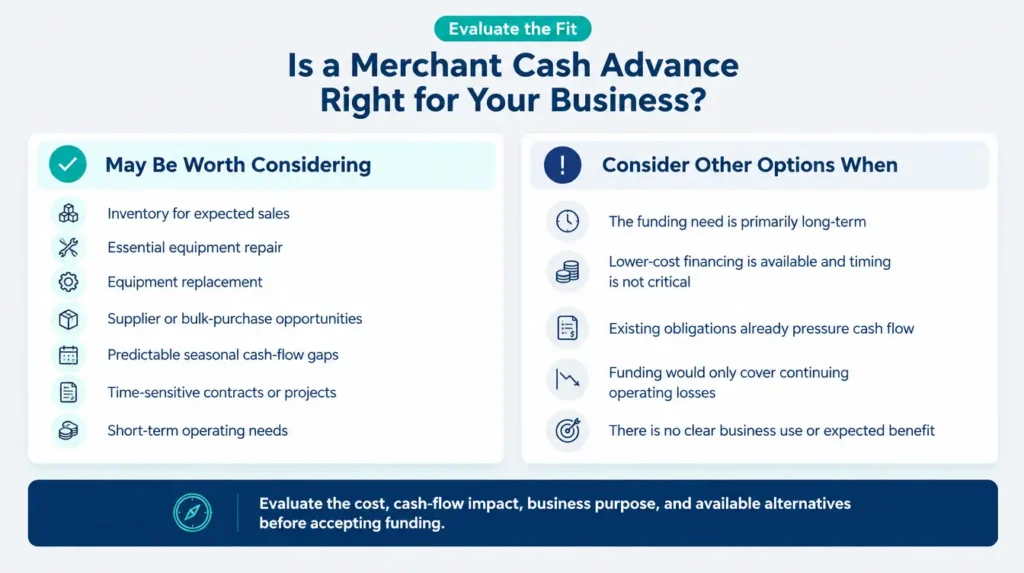
When Might a Merchant Cash Advance Make Sense?
A merchant cash advance is generally easier to evaluate when the business has a specific use for the capital and a clear reason why timing matters.
Common business uses may include:
Inventory
A retailer, restaurant, wholesaler, or e-commerce business may need additional inventory before a high-demand period or to fulfill an unusually large order.
Essential Equipment
Capital may help repair or replace equipment that is currently affecting the company’s ability to generate revenue.
Seasonal Cash-Flow Needs
A business with predictable seasonal fluctuations may need working capital while expenses arrive before the next stronger revenue period.
Supplier Opportunities
A business may identify a time-sensitive purchasing opportunity, such as securing inventory or materials at favorable commercial terms.
Time-Sensitive Contracts or Projects
Additional capital may help a company purchase materials, cover initial operating expenses, or prepare to fulfill a contract.
Short-Term Operating Needs
Working capital can help a business address a temporary mismatch between incoming revenue and immediate operating expenses.
An MCA may be less appropriate when the need is primarily long term, the expected business benefit is unclear, or existing obligations already place significant pressure on cash flow.
Merchant Cash Advance vs. Business Cash Advance
The terms merchant cash advance and business cash advance are sometimes used in overlapping ways within the business funding market.
The name alone should not determine how you evaluate an offer.
Instead, review how the transaction is actually structured, including the amount provided, purchased amount, remittance arrangement, fees, reconciliation provisions, and other agreement terms.
Business owners who are ready to explore Legend’s commercial funding options can review the current business cash advance program.
This article focuses specifically on understanding merchant cash advances from an informational perspective.
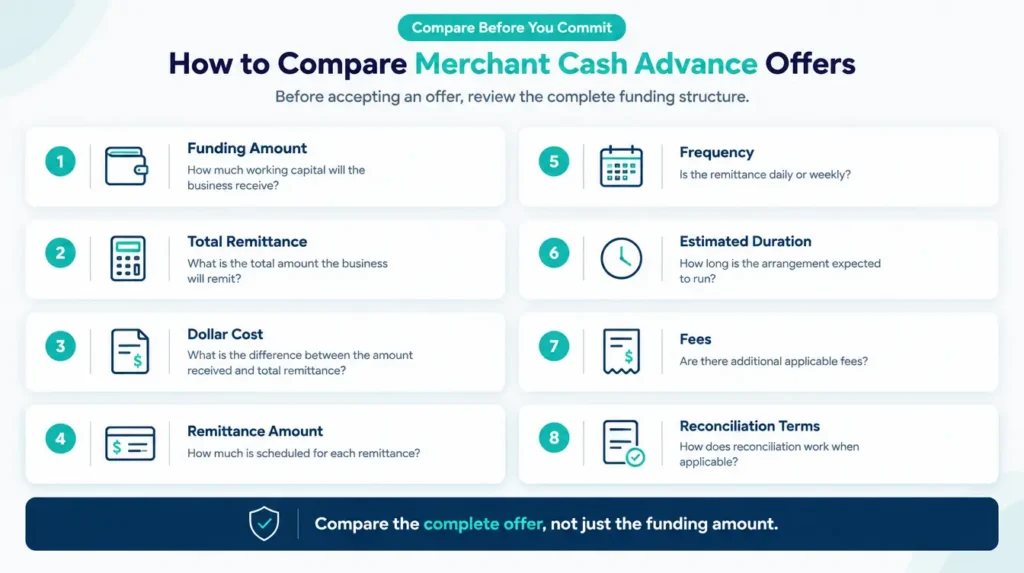
How to Compare Merchant Cash Advance Offers
Before accepting an MCA, compare the complete economic and contractual structure rather than choosing an offer based only on the largest funding amount.
The largest funding amount is not automatically the strongest offer.
Use the following checklist as your main comparison framework:
| What to Compare | What to Ask |
| Funding amount / net proceeds | How much money will actually reach the business? |
| Purchased amount | What total amount is being purchased and ultimately remitted? |
| Dollar cost | What is the difference between the net proceeds and purchased amount? |
| Remittance amount | How much is scheduled to be remitted at each interval? |
| Frequency | Are remittances daily or weekly? |
| Estimated duration | Based on the scheduled structure, how long is the arrangement expected to run? |
| Fees | Are there additional applicable fees? |
| Reconciliation | Does the agreement contain a reconciliation process, and how does it work? |
| Default provisions | What circumstances are defined as default and what happens next? |
Two offers with similar funding amounts can affect a business very differently.
The complete cost, remittance burden, agreement terms, and effect on working capital matter more than the headline amount alone.king a decision.
How to Choose a Merchant Cash Advance Provider
Choosing a provider should involve more than comparing how quickly a company promises to fund.
Look for clarity around:
- Who is actually providing the capital
- Who performs underwriting
- The total purchased amount
- Remittance structure
- Applicable fees
- Reconciliation terms
- Default provisions
- Who you can contact with questions
- Whether the complete terms are available before signing
Legend is a direct funder and handles underwriting in-house.
Working directly with the funding source can also make it easier to ask questions about an offer before entering into an agreement.
How to Apply for Merchant Cash Advance Funding With Legend
The application process begins with basic business information and requested financial documentation.
Step 1: Submit Your Information
Provide the requested business details and recent bank statements.
Step 2: Underwriting Review
Legend’s in-house underwriting team reviews the business’s revenue, deposit activity, time in business, industry, existing obligations, and overall cash-flow position.
Step 3: Review the Offer
If an offer is available, review the terms carefully before signing.
Use the comparison table above to evaluate the offer rather than focusing only on the funding amount.
Step 4: Complete Funding
Once the application, verification, and agreement requirements are completed, approved funds can be deposited into the business bank account.
Businesses interested in applying can visit the merchant funding application.
For questions before applying, contact Legend Advance Funding.
Check My Merchant Funding Options
Is a Merchant Cash Advance Right for Your Business?
There is no universal answer.
Whether an MCA fits a business depends on:
- why the capital is needed
- how quickly it is needed
- the expected business benefit
- the total dollar cost
- the remittance structure
- existing obligations
- the business’s ability to maintain sufficient operating cash flow
An MCA May Be Worth Evaluating When:
- the business generates consistent revenue
- there is a specific use for the capital
- timing is important
- the capital addresses a defined operational need or business opportunity
- the total cost is clearly understood
- projected cash flow can reasonably support the remittance structure
- the complete agreement has been reviewed
Consider the Financial Impact Carefully When:
- operating cash flow is already under significant pressure
- frequent remittances may interfere with payroll or essential expenses
- the business does not have a defined use for the capital
- the expected financial benefit is uncertain
- existing obligations already consume a significant portion of available cash flow
- the total remittance amount is unclear
- reconciliation provisions are not understood
- important agreement terms remain unanswered
A sound funding decision should address a business need without creating a larger cash-flow problem.
If you have questions about Legend’s current merchant criteria or need clarification before submitting business information, you can contact Legend Advance Funding directly.
Final Takeaway
A merchant cash advance can provide working capital when a business has a specific, time-sensitive need, but access to capital is only one part of the decision.
Before accepting an MCA, understand how the transaction works, what the capital will cost in dollars, how remittances will affect cash flow, what the agreement says about changing revenue, and what alternatives are available.
The strongest funding decision is one that solves a defined business need without creating an obligation the business cannot reasonably support.
If you are ready to explore your options, visit the merchant funding application or contact Legend Advance Funding.
Disclosure
Merchant cash advance terms vary by business, offer, and funding agreement. All funding is subject to underwriting, verification, approval, and completion of applicable documentation. This content is provided for general informational and educational purposes only and does not constitute legal, tax, or financial advice. Review all agreement terms carefully and consult an appropriate professional when necessary.