

If your bank declined your business, you still have options. Non-bank funders look at different things than banks do, and some, like merchant cash advance providers, underwrite mainly on your business deposits rather than on collateral or a long credit history. Start by finding out why the bank said no, because that tells you which option is realistic and what to fix.
Why Do Banks Decline Small Businesses?
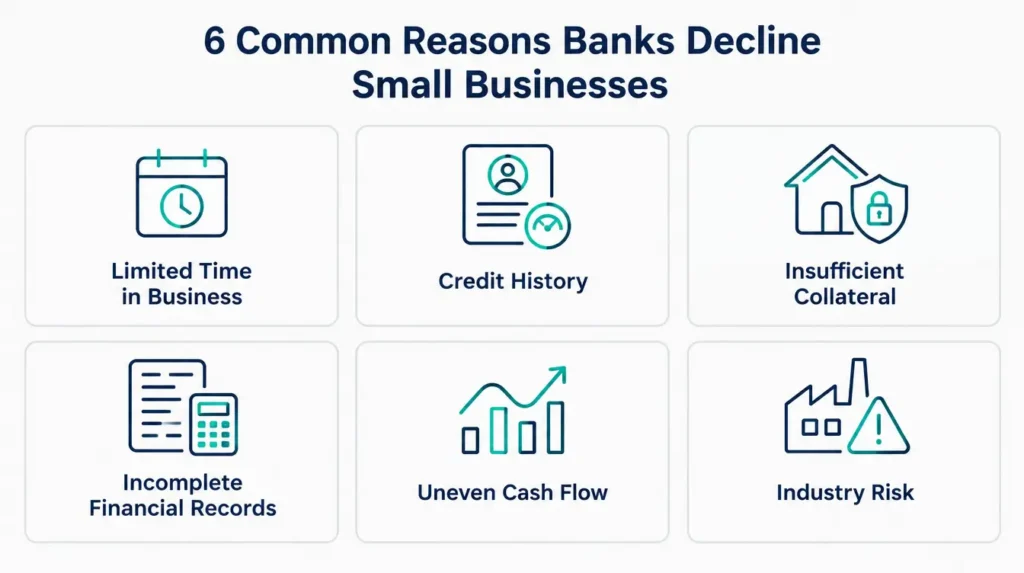
Banks are built for lower-risk, well-documented borrowers. Common reasons a bank says no include:
- Not enough time in business. Many banks want a longer operating history than a young business has.
- Credit history. A personal or business credit score below the bank’s cutoff can end the application.
- No collateral. Banks often want assets to secure the loan.
- Financial statements. Missing, thin or inconsistent tax returns and financials make a bank file hard to approve.
- Cash flow that looks uneven on paper. Seasonal or lumpy revenue can fail a bank’s ratio tests even when the business is healthy.
- Industry. Some banks limit lending to industries they consider higher risk.
Ask your bank which reason applied. It is the most useful thing you can take away from a decline.
What Are Your Non-Bank Funding Options?
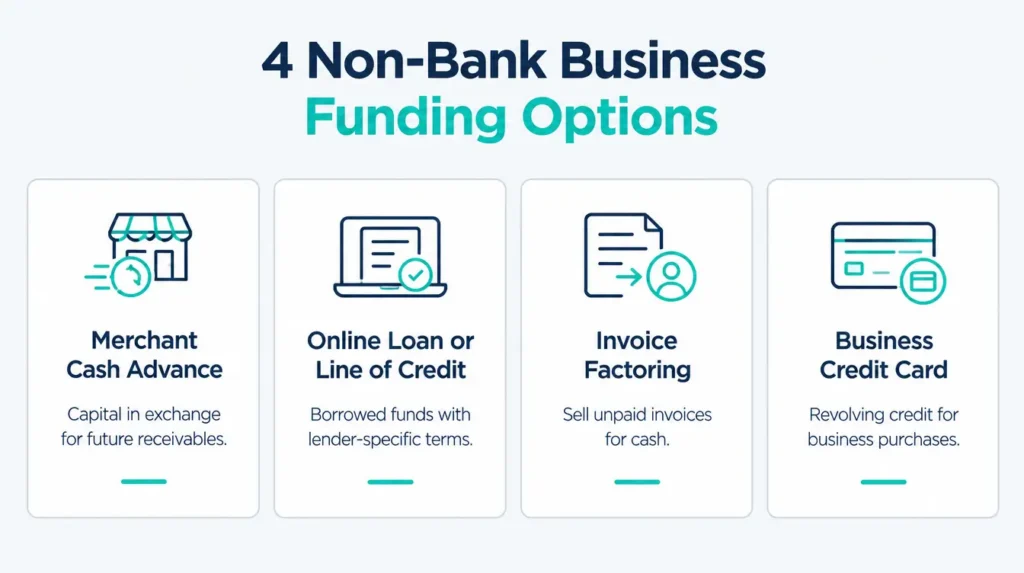
| Option | What it is | What it usually looks at | Best fit |
| Merchant cash advance | Lump sum in exchange for a fixed dollar amount of future receivables, remitted daily or weekly. Not a loan | Business deposits, revenue consistency, time in business | Short-term, time-sensitive needs |
| Online term loan or line of credit | Borrowed funds from a non-bank lender, paid back with interest | Credit and revenue; varies by lender | Businesses close to bank standards that need a faster process |
| Invoice factoring | Selling specific unpaid invoices to a factoring company | The creditworthiness of your customers | Businesses waiting on slow-paying customers |
| Business credit card | Revolving card credit | Personal and business credit | Small, short purchases you can pay off quickly |
Each option carries its own cost and trade-offs. Compare the total dollar cost, the payment schedule and what happens if your revenue drops before you choose. For a closer look at three of them, see our comparison of a merchant cash advance, line of credit and term loan.
Legend Advance Funding offers merchant cash advances only.
How Is a Merchant Cash Advance Different From a Bank Loan?
A merchant cash advance is the purchase of a fixed dollar amount of your future receivables, not a loan. Underwriting focuses on how much revenue moves through your business bank account and how consistent it is. That is why a business a bank turned down can still be considered.
At Legend Advance Funding:
| Requirement | Our baseline |
| Time in business | 3 months or more |
| Monthly revenue | $20,000 or more |
| Business bank account | Active US business checking account |
| Personal credit | No strict minimum FICO for most programs |
| Existing advances | Reviewed case by case |
Advances range from $20,000 to $3,000,000. Decisions generally come within 24 hours of a complete application, and funding typically arrives within 24 to 48 hours after approval.
When Does a Merchant Cash Advance Make Sense After a Bank Decline?
It can make sense when:
- The bank said no because of time in business, collateral or credit, but your deposits are steady.
- You have a specific, time-sensitive use for the money, such as stock, a repair that is stopping revenue, or payroll through a known slow period.
- You can see how the capital pays for itself within the advance term.
When Is a Merchant Cash Advance the Wrong Choice?
It is usually the wrong choice when:
- The bank said no because the business is losing money, and the capital would only delay the problem.
- You need long-term financing for an expansion and could qualify for a bank product if you wait or fix one item, such as your financial statements.
- Your deposits already struggle to carry existing obligations, including another advance.
- You are not sure what the money is for.
A merchant cash advance usually costs more than a bank loan. If you can qualify for bank financing and can wait for it, that will generally be the less expensive route.
What to Do Next
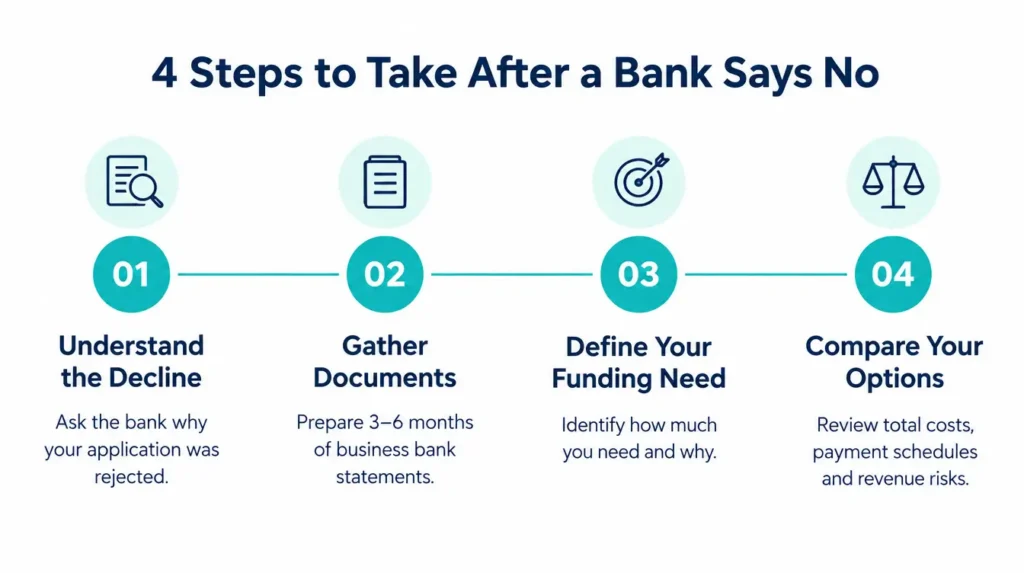
- Ask the bank for the reason it declined.
- Gather your last 3 to 6 months of business bank statements; most non-bank funders start there.
- Decide what the money is for and how much you actually need.
- Compare at least two options on total dollar cost, payment schedule and what happens if revenue drops.
If you are worried about being declined again, read why merchant cash advance applications get declined before you apply. To understand the product first, see our guide to what a merchant cash advance is.
See What Your Business Qualifies For
If a bank said no but your business has steady deposits, check your options. Applying takes about five minutes.
Check My Merchant Funding Options
Merchant cash advance terms vary by business and funding agreement. All funding is subject to underwriting, verification and approval. Available to US businesses only.