
A merchant cash advance (MCA) provides a business with upfront capital in exchange for an agreed amount of future business revenue or receivables.
The process generally moves through five main stages: submitting an application and business information, completing the business and cash-flow review, reviewing the MCA offer and agreement, completing verification and receiving funding, and making agreed remittances until the purchased amount is satisfied.
Understanding those five steps is important, but the mechanics behind the transaction matter just as much.
A business owner should understand the amount of capital received, total purchased amount, pricing structure, remittance amount or percentage, remittance frequency, estimated timeframe, fees, reconciliation provisions, and other terms contained in the agreement.
This guide explains how a merchant cash advance works from application through final remittance.
Key Takeaways
- A merchant cash advance provides upfront business capital in exchange for an agreed amount of future business revenue or receivables.
- The process generally includes five stages: application, business review, offer review, funding, and remittances.
- MCA underwriting commonly focuses on business revenue, deposit activity, cash flow, and existing obligations.
- An MCA offer should be evaluated based on the purchased amount, pricing structure, remittance method, payment frequency, fees, and reconciliation provisions, not just the amount received.
- A factor rate is a pricing multiplier sometimes used in MCA transactions and should not be treated as the same thing as an APR.
- Remittances may be tied to a percentage of eligible revenue or structured as daily or weekly ACH withdrawals, depending on the agreement.
- The effect of changing revenue depends on the remittance structure and any reconciliation provisions in the contract.
- Business owners should understand how the proposed remittance could affect operating cash flow before accepting an offer.
How Does a Merchant Cash Advance Work in 5 Steps?
Here is the process at a glance:
| Step | What Happens | What to Pay Attention To |
| 1. Apply | The business submits information and requested financial documents. | Complete and accurate business information |
| 2. Business Review | The provider reviews revenue, deposits, cash flow, existing obligations, and other underwriting factors. | How the business’s current cash flow is evaluated |
| 3. Review the Offer | The business receives and evaluates the proposed MCA terms. | Advance amount, purchased amount, pricing, remittance structure, fees, and agreement terms |
| 4. Receive Funding | Required verification and documents are completed before approved funds are provided. | Final agreement and funding details |
| 5. Remit Future Revenue | Daily or weekly remittances are made according to the agreement until the purchased amount is satisfied. | Amount, frequency, revenue adjustments, and reconciliation provisions |
The exact process can vary depending on the provider, business, underwriting review, and specific agreement.
The contract should always determine what a particular business is agreeing to.
What Is a Merchant Cash Advance?
A merchant cash advance is a form of business financing in which a business receives capital upfront in exchange for an agreed amount of future business revenue or receivables.
Depending on the agreement, remittances may be tied to a percentage of eligible business receipts or structured as daily or weekly ACH withdrawals. Other collection structures may also be defined in the agreement.
Pricing may be expressed using a factor rate or another method rather than a conventional annual interest rate.
Because of those differences, evaluating an MCA involves more than asking:
“How much funding can I receive?”
A business owner should also ask:
“How much will I ultimately remit, how will those remittances work, and what effect could they have on my operating cash flow?”
For a broader explanation of the product, including costs, qualification, potential advantages, limitations, use cases, and other considerations, read our complete Merchant Cash Advance guide.
Step 1: Submit the MCA Application and Business Information
The merchant cash advance process begins with an application.
The funding provider needs enough information to understand the business, verify its operations, and begin evaluating whether its current revenue and cash-flow profile can support the proposed transaction.
Information requested during the application process can include the legal business name, business address, industry, time in business, ownership details, requested funding amount, banking information, recent business bank statements, payment-processing information when applicable, and details about existing financing obligations.
The exact documentation requirements vary by provider and transaction.
Why Are Business Bank Statements Important?
Bank statements can help an underwriter understand how money moves through the business.
Instead of showing only total revenue, they can provide a clearer view of deposit frequency, deposit consistency, average balances, cash-flow fluctuations, existing withdrawals, financing obligations, negative-balance activity, and other patterns that may be relevant to underwriting.
Two businesses with similar monthly revenue can have very different cash-flow profiles.
For example, one business may receive steady deposits throughout the month and maintain adequate operating cash. Another may generate the same total monthly revenue but experience significant swings in deposits or already have substantial financial obligations.
That is why MCA underwriting usually involves more than simply asking how much revenue the business generates.
What Documents May Be Needed for an MCA?
Recent business bank statements are commonly part of the review process, but additional documentation may be requested depending on the business and transaction.
Those documents can help verify the business’s identity, ownership, banking information, operating activity, revenue, and existing obligations.
Providing accurate and complete information gives the provider a clearer picture of the business’s financial activity and can reduce unnecessary back-and-forth during the review process.
Step 2: The Provider Reviews Revenue and Cash Flow
After the application and requested documents have been submitted, the provider begins underwriting.
Because future business revenue is central to an MCA transaction, underwriting generally places substantial emphasis on the business’s existing revenue and cash-flow activity.
What Does an MCA Underwriter Look For?
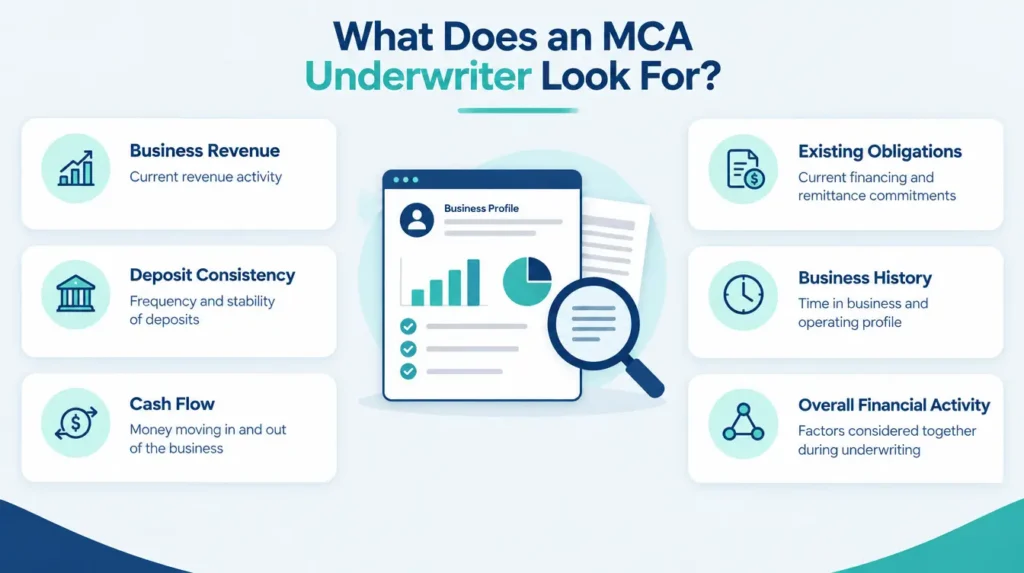
An underwriter may examine monthly revenue, deposit frequency and consistency, recent changes in revenue, average bank balances, negative-balance activity, existing financing obligations, current remittance commitments, time in business, industry, credit information where applicable, and the overall ability of the business’s cash flow to support the proposed structure.
The exact underwriting criteria vary by provider, and no single factor should be assumed to guarantee approval.
The larger question an underwriter may be trying to answer is:
Can the business’s current cash flow support the proposed funding structure alongside its operating expenses and existing obligations?
That distinction matters.
A business may generate substantial revenue but still have limited available cash after payroll, inventory, rent, taxes, suppliers, existing financing, and other operating expenses.
For additional information, review Legend Advance Funding’s merchant funding guidelines to learn more about the guidelines that may apply during the funding review process.
What Guidelines Does Legend Advance Funding Review?
Legend Advance Funding’s merchant funding guidelines include at least 3 months in business and $20,000 or more in monthly revenue. There is no strict FICO minimum, and businesses with existing positions are reviewed on a case-by-case basis. All funding remains subject to underwriting, verification, and approval.
Can I Apply With an Existing Position?
Existing positions do not automatically prevent a business from being considered. Legend Advance Funding reviews open positions on a case-by-case basis as part of the overall underwriting review.
Step 3: Review the Merchant Cash Advance Offer
If an offer becomes available, reviewing the agreement carefully is one of the most important parts of the MCA process.
The amount of funding offered should not be the only number considered.
A business owner should understand the complete economics and structure of the transaction, including the advance amount, purchased amount, factor rate or other pricing structure, remittance method, remittance frequency, estimated completion timeframe, applicable fees, reconciliation provisions, early-payment terms, default provisions, and other contractual requirements.
Let’s break down the major components.
What Is the Advance Amount?
The advance amount is the amount of capital being provided to the business, subject to any deductions or fees described in the agreement.
For example, a hypothetical MCA might show:
Advance amount: $50,000
That number tells you how much capital is associated with the transaction, but it does not tell you the total cost or total amount that must ultimately be remitted.
For that, you need to examine the pricing structure and purchased amount.
What Is a Factor Rate on a Merchant Cash Advance?
Some merchant cash advances use a factor rate to calculate the total amount associated with the transaction.
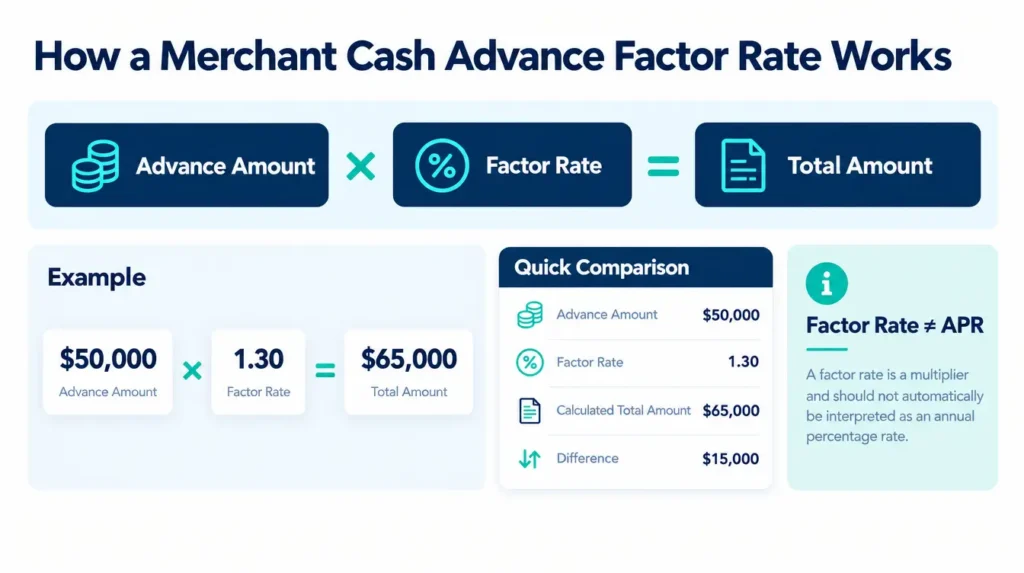
A factor rate is expressed as a multiplier.
The basic calculation is:
Advance Amount × Factor Rate = Total Calculated Amount
Consider a hypothetical example:
$50,000 × 1.30 = $65,000
| Item | Amount |
| Advance amount | $50,000 |
| Factor rate | 1.30 |
| Calculated total amount | $65,000 |
| Difference | $15,000 |
These figures are hypothetical and are provided only to explain the calculation. They do not represent an offer, rate, cost, or funding term from Legend Advance Funding.
What Is the Purchased Amount?
The purchased amount generally refers to the amount of future receivables or revenue covered by the transaction according to the agreement.
This figure is important because it allows the business to compare the capital received with the total amount contractually required to be remitted.
Using the hypothetical example above, a business receiving $50,000 with a calculated purchased amount of $65,000 would need to evaluate the difference as part of the overall economics of the transaction.
The agreement should clearly explain the applicable purchased amount and how it is calculated.
How Are MCA Remittances Calculated?
The agreement should explain how the purchased receivables will be delivered to the provider.
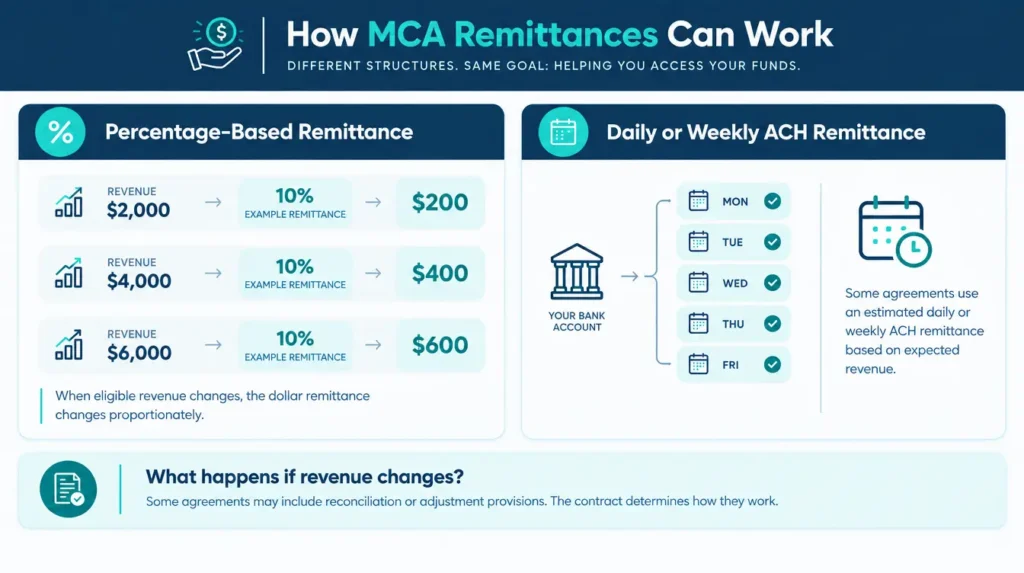
Two structures commonly discussed in MCA transactions are percentage-of-revenue remittances and daily or weekly ACH remittances.
The mechanics differ, so business owners should understand which structure applies to their specific agreement.
Percentage-of-Revenue Remittances
In a percentage-based arrangement, a specified percentage of eligible business receipts is delivered to the provider.
Consider a simplified hypothetical example with a 10% remittance percentage.
If eligible business revenue for a period is $4,000, a 10% remittance would equal $400.
If eligible revenue falls to $2,000, the same 10% remittance would equal $200.
The percentage stays the same, but the dollar amount changes as eligible revenue changes.
| Eligible Revenue | Example Remittance Percentage | Dollar Remittance |
| $2,000 | 10% | $200 |
| $4,000 | 10% | $400 |
| $6,000 | 10% | $600 |
This illustrates one of the central mechanics of a percentage-of-revenue structure: when eligible revenue changes, the dollar remittance changes as well.
Daily or Weekly ACH Remittances
Other MCA arrangements may use an estimated daily or weekly ACH amount based on expected business revenue.
For example, the agreement may establish an expected remittance amount that is withdrawn from the business account according to a specified schedule.
That does not necessarily mean the MCA functions like a conventional fixed-payment installment loan.
The agreement may include contractual provisions addressing actual business revenue, including reconciliation or adjustment procedures.
The specific rights and requirements depend on the agreement.
What Is MCA Reconciliation?
Reconciliation is a contractual process that may allow an estimated or fixed remittance to be compared with the business’s actual revenue.
Where the agreement provides a reconciliation right, changes in actual revenue may potentially result in an adjustment to the remittance.
The contract should explain whether reconciliation is available, when it can be requested, what documentation is required, how an adjustment is calculated, and when an approved adjustment becomes effective.
Businesses should not assume every MCA agreement contains identical reconciliation provisions.
Before signing, one useful question to ask is:
“If my revenue decreases, how does reconciliation work under this specific agreement?”
What Happens If Business Revenue Goes Up or Down?
The answer depends on the remittance structure.
With a percentage-based structure, the dollar remittance generally rises when eligible revenue rises and decreases when eligible revenue falls. If revenue remains relatively stable, the remittance generally stays proportionate to those receipts.
With an estimated daily or weekly ACH structure, the scheduled amount may initially remain unchanged even if business revenue changes.
That makes it particularly important to understand any reconciliation or adjustment provisions contained in the agreement.
The contract should determine what happens when actual revenue differs from the assumptions used to establish the remittance.
Step 4: Complete the Agreement and Funding Process
Once the business has reviewed an available offer and decides to proceed, additional documentation or verification may be required.
This stage can involve signing the funding agreement, confirming ownership and business information, verifying the business bank account, completing requested stipulations, and completing any remaining underwriting or funding verification.
Once applicable underwriting, verification, approval, and documentation requirements have been satisfied, approved funding can be provided according to the agreement.
For a broader overview of how Legend Advance Funding handles the journey from submission through review and funding, visit the Legend funding process. That page is particularly relevant to ISOs and brokers working through the submission and underwriting workflow.
Legend Advance Funding’s stated timing is a decision within 24 hours, with funding in 24 to 48 hours. Actual timing may depend on application completeness, required documentation, verification, underwriting, and bank processing.
Step 5: Remittances Begin
After funding, the business begins remitting the agreed amount of future revenue or receivables according to the contract.
The transaction may use percentage-based remittances, daily ACH withdrawals, weekly ACH withdrawals, or another collection structure defined by the agreement.
The agreement should make clear how each remittance is calculated, how frequently it occurs, which account is used, what happens if revenue changes, whether reconciliation is available, how the purchased amount is tracked, and when the transaction is considered complete.
Merchant Cash Advance Example: How the Numbers Work
A complete hypothetical example can make the process easier to understand.
Assume a business receives the following hypothetical offer:
| Item | Hypothetical Amount |
| Advance amount | $50,000 |
| Factor rate | 1.30 |
| Calculated purchased amount | $65,000 |
| Difference | $15,000 |
| Example revenue-remittance percentage | 10% |
Assume the transaction uses a percentage-of-revenue structure.
On Day 1, the business generates $4,000 in eligible revenue. A 10% remittance would equal $400.
On Day 2, eligible revenue falls to $2,000. The 10% remittance would therefore equal $200.
On Day 3, eligible revenue rises to $6,000. The corresponding remittance would equal $600.
This example demonstrates an important characteristic of a percentage-based structure:
The dollar remittance changes as eligible revenue changes.
The purchased amount in this hypothetical example remains $65,000, but the amount remitted during each period depends on eligible revenue.
The length of time needed to satisfy the purchased amount could therefore vary.
Example disclaimer: These figures are hypothetical and are provided only to explain how MCA mechanics can work. They do not represent an offer, rate, pricing structure, approval, or funding term from Legend Advance Funding.
How Long Does a Merchant Cash Advance Last?
There is no single universal completion period for every merchant cash advance.
The actual timeframe can depend on the purchased amount, remittance percentage or amount, business revenue, remittance frequency, contract structure, reconciliation provisions, and other agreement terms.
With a percentage-of-revenue structure, increased revenue may result in larger dollar remittances and potentially satisfy the purchased amount sooner.
If revenue decreases, individual percentage-based remittances may be smaller, potentially extending the time needed to satisfy the purchased amount.
That is why an estimated timeframe should not automatically be treated as a guaranteed completion date.
If an MCA offer includes an estimated timeframe, business owners should understand the assumptions used to calculate it.
What Happens When the Purchased Amount Is Fully Remitted?
Once the business has delivered the purchased amount and satisfied its applicable contractual obligations, the remittance obligation associated with that advance should conclude according to the agreement.
At that point, the business should retain copies of its funding agreement, disclosure documents, remittance records, bank records, account statements, and any completion documentation provided.
If the business later considers additional funding, that should be evaluated as a new financial decision.
Current revenue, available cash flow, existing obligations, funding needs, cost considerations, and available alternatives should all be reviewed again.
Receiving one MCA does not automatically mean another advance is appropriate for the business.
Businesses that want to understand other available structures can review Legend Advance Funding’s business funding programs. The current programs section is primarily structured for ISO and broker audiences, so the terms of any specific merchant offer should still be reviewed independently.
7 Things to Check Before Accepting a Merchant Cash Advance
Understanding how an MCA works is important, but the most important evaluation happens when reviewing an actual offer.
1. How Much Money Will the Business Actually Receive?
Look at the amount expected to reach the business account after any applicable deductions or fees described in the agreement.
The headline advance amount may not always tell the entire story.
2. What Is the Total Purchased Amount?
Compare the amount received with the total amount of receivables covered by the agreement.
Understanding the total contractual amount makes it easier to evaluate the complete transaction.
3. How Is the Cost Calculated?
Determine whether the offer uses a factor rate, another pricing method, additional fees, or other contractual charges.
Do not evaluate the transaction based on a single pricing number without understanding how the total cost is calculated.
4. How Much Will Be Remitted Daily or Weekly?
Consider the proposed remittance relative to normal operating cash flow.
Payroll, inventory, rent, suppliers, taxes, utilities, existing financing obligations, and other operating expenses continue while the business is making remittances.
The question is not only whether the business can access capital, but whether the cash-flow structure remains manageable after funding.
5. Is the Remittance Percentage-Based or Estimated?
This can affect what happens when revenue changes.
Ask exactly how each remittance is calculated and what procedures apply during periods of lower revenue.
6. What Fees and Reconciliation Terms Apply?
Read the agreement carefully for provisions relating to fees, reconciliation, adjustments, early completion, default, security interests or personal guarantees where applicable, and other contractual obligations.
Not every MCA agreement contains the same provisions.
7. Can the Business’s Cash Flow Support the Remittance?
This is one of the most important practical questions.
Access to capital can help a business only if the financing structure remains manageable alongside ordinary operating expenses.
Evaluate the expected benefit of the capital against the effect the remittance could have on day-to-day liquidity.
How Does the Merchant Cash Advance Process Work With Legend Advance Funding?
At Legend Advance Funding, the general merchant funding process begins with information about the business and its funding request.
The submitted information is reviewed as part of the underwriting process. If an offer is available, the business should review the proposed funding amount, purchased amount, remittance structure, remittance frequency, pricing, fees, estimated timeframe, and other agreement terms.
Any remaining verification, documentation, and agreement requirements must then be completed before approved funding can proceed.
After funding, the business follows the remittance structure described in its specific agreement until the purchased amount and applicable contractual obligations have been satisfied.
All funding is subject to underwriting, verification, approval, and completion of applicable documentation.
Business owners considering this type of financing can learn more about merchant funding from Legend Advance Funding.
For brokers and Independent Sales Organizations placing merchant funding transactions, Legend also provides information about its ISO Partner program, including its submission and underwriting relationship with partners.
Disclosure: Merchant cash advance terms vary by business, provider, offer, and funding agreement. Funding is subject to underwriting, verification, approval, and completion of applicable documentation. This article is for general educational purposes only and does not constitute legal, tax, or financial advice. Review the full funding agreement and consult a qualified professional when appropriate.